First Annual Wyoming Herpetology Symposium - Nov 14th!
The Wyoming Herpetological Society (LINK) has organized the first annual Wyoming Herpetology Symposium to be held on the University of Wyoming campus in Laramie on November 14th, 2026 from 10am until 4pm. This is a great opportunity to connect with fellow herpetological enthusiasts.
Registration is free!
Read More
New Paper: Morphological and genomic responses to hurricanes arise and persist during a biological invasion
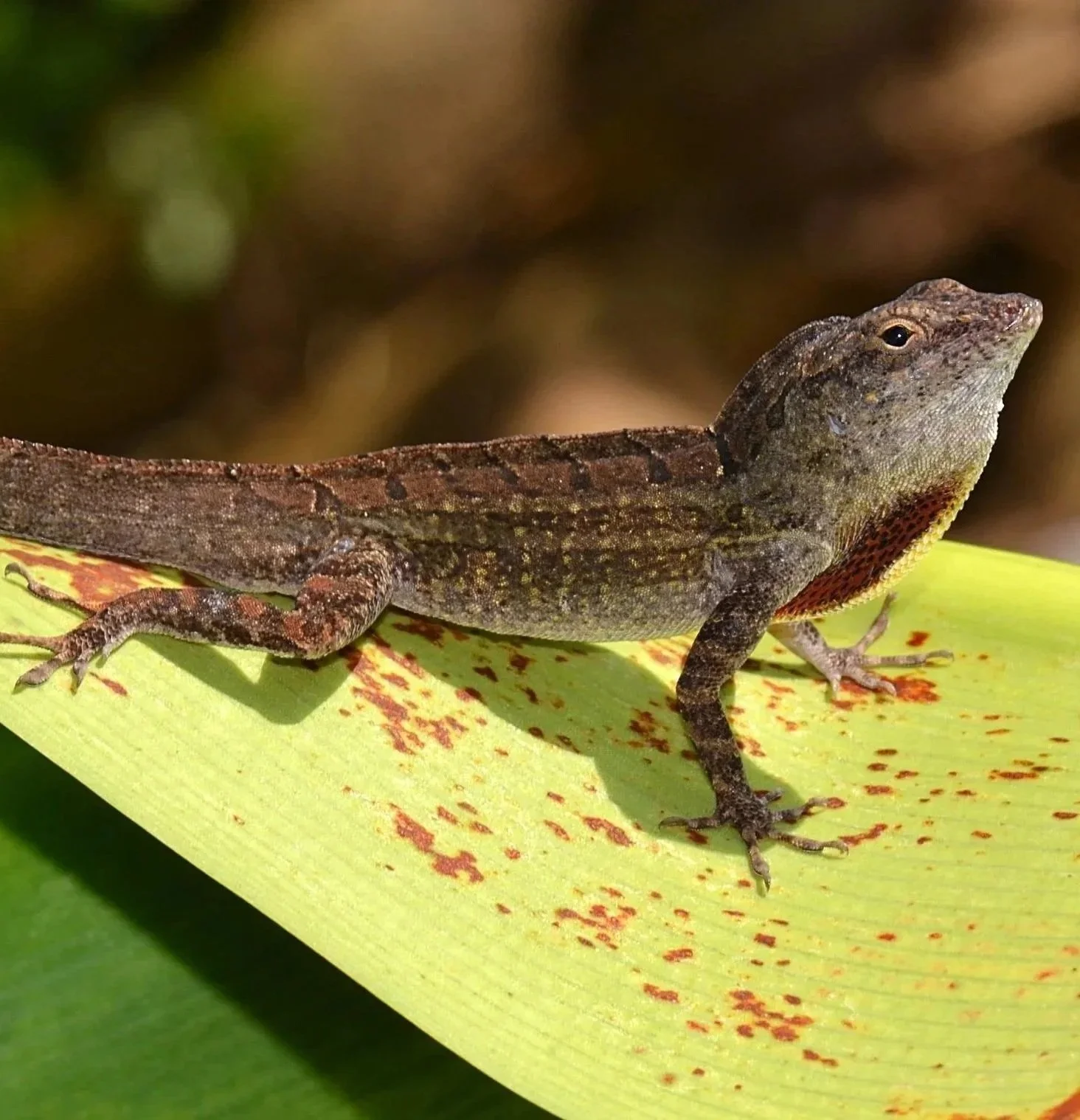
In brief, we find Florida-wide morphological and genomic signatures of hurricane-driven evolution of limbs and toe pads in the Brown anole.
Adult male brown anole (Anolis sagrei). Credit: Jonathan Losos.
Read More
The lab is moving to the University of Wyoming!
In spring 2026 the lab is moving to the Department of Zoology and Physiology at the University of Wyoming!
Read More
New grant to study the ecological and evolutionary effects of hurricanes using long-term data
We have been awarded a new NSF grant to collate and analyze decades of ecological and evolutionary data from The Bahamas. We’re super excited to get started!
Read More
New grant to enhance our mesocosm facility!
We received a generous grant from the 1804 Fund to expand and upgrade our mesocosm facility! These funds will pay for a wide range of upgrades to our mesocosm facility here at OU! There are too many enhancements to list here, but the primary item will be installation of a high-capacity, all-season electrical supply dedicated to the mesocosm facility. This upgrade will enable a much wider range of experiments as well as continuous sensing of water parameters. Thanks to the 1804 Fund for it’s generous support!
Read More
New Paper: Ecosystem effects of intraspecific variation in a color polymorphic amphibian
Can intraspecific variation in a widespread, common salamander affect aquatic ecosystems? That’s the question that Jon Davenport (Appalachian State University) and I set out to answer. Using a mesocosm experiment we show that yes, evolved intraspecific color variation in Spotted Salamanders just might be ecologically relevant!
Read More
We have THREE open paid PACE positions. One for summer 2024, and TWO for fall/spring semesters!!
Positions are focused on the ecology and evolution of reptiles and amphibians. Prior expertise in these organisms is not required. See the OU webpage for PACE application information: www.ohio.edu/financial-aid/types/employment/pace
Read More
Starting as Assistant Professor at Ohio University August 2023!!!
The Department of Biological Sciences at OU has a great foundation in Evolutionary Ecology and I’m pleased to be joining this group of tremendous researchers. Prospective graduate students and interested postdocs should use this form to inquire about opportunities in the lab.
Ohio University is located in Athens— a small, affordable town nestled in the low hills of southeastern Ohio. Come join us!
Read More
New Paper: Using mechanistic insights to predict the climate-induced expansion of a key aquatic predator
How will species respond to climate change? Will their ranges expand as mechanisms limiting their geographic range are weakened? In this new paper led by Mark Urban, we develop a mechanistic model that explains current distribution of marbled salamanders at their northern range limit and then project their range expansion given multiple climate change scenarios. The upshot is that marbled salamanders are likely to occupy a larger fraction of ponds and will expand their range north over the next century. A terrific integrative effort by the Urban lab!!
Read More
New Paper: Body size predicts the rate of contemporary morphological change in birds
Super excited to share the results of a recent collaboration with Marketa Zimova et al. on their analysis of long-term data on morphological shifts in birds. Essentially, we show that small bird species are changing faster that larger ones. Interestingly, the effects of body size appear independent of generation length suggesting that body size itself is important for determining the strength of selection or the response to it. Either way, these data provide new insights into an explosion of research showing contemporary shifts in body size and morphology is wild vertebrates.
Read More
New Paper: An eco-evolutionary perspective on the humpty-dumpty effect and community restoration
Terrific artwork and text summaries by Abby McBride/Sketch Biologist featuring our recent Oikos Forum paper: An eco-evolutionary perspective on the humpty-dumpty effect and community restoration. A great paper led by Dr. Annette Evans that leverages the Humpty-Dumpty metaphor to explore the role of contemporary evolutionary change in the restoration of communities and ecosystem. It was a great exercise; one that we believe will help a wide range of ecologists and conservationists frame the various outcomes of ecological restorations. It’s wonderful to see this wonderful supplemental coverage by Oikos!
Read More
New Paper: Hierarchical partitioning of multiple niche dimensions among ecomorphs, species and sexes in Puerto Rican anoles
Cool new paper on resource use in Puerto Rico anole lizards with Drs. Ingram and Losos. We examined variation in structural microhabitat, thermal habitat, and prey use in an assemblage of six anoles belonging to three ecomorph categories in a Puerto Rico. Our analysis largely corroborates existing hypotheses that anole adaptive radiation and community assembly is predictable with clear structural habitat divergence among ecomorphs, and secondary divergence within ecomorphs (i.e., among species) using different climatic niches. The hierarchical approach we employ presents opportunities for a comparative approach to understanding how ecological diversity is partitioned within communities.
Read More
New Paper: Establishment of the introduced Brahminy blindsnake on Abaco Island, The Bahamas, with notes on potential niche overlap with the native Cuban brown blindsnake
After the establishment of the Brahminy blind snake (top panel), Abaco Island in the Bahamas now has two species of blind snakes. Similarities between this global invasive and the native Cuban brown blind snake (bottom panel) suggest that this new introduction is a potential threat. Over the last several years, multiple species of reptile and amphibians have invaded and become established on Abaco. Photo credit Tyler B. Devos.
Read More
New Paper: Microgeographic evolution of metabolic physiology in a salamander metapopulation
Measuring standard metabolic rate of spotted salamander larvae. In this study, we tested a widespread assumption that metabolic rate does not evolve within species. Our results show that in fact, metabolic physiology does exhibit microevolutionary variation - at metapopulation-level spatial scales. These findings suggest that evolved differentiation in metabolic physiology occurs at the finest of spatial scales.
Read More
New Paper: Balancing selection and drift in a polymorphic salamander metapopulation
Spotted salamanders (Ambystoma maculatum) produce two kinds of egg jelly, white and clear. Females deposit these egg masses on the bottom of temporary ponds in spring.
Read More
New Paper: Increasing mismatch in Scotland's mountain hares
A new paper led by Marketa Zimova from the University of Michigan uses historical resurveys to show that rapid climate change and static molt phenology in a seasonally color-changing mammal, the mountain hare, has resulted in a continuing decline in camouflage.
Read More
Ongoing Research: SNAPSHOT USA 2020 Cameras launched!!
Last year Market and I deployed our camera trap array at Kellogg Biological Station in SW Michigan. This year, we’re surveying Central Pennsylvania, just a few miles from State College. We’ve got our 12 cameras out in Rothrock State Forest (with permits). A quick checkup on batteries and SD card showed this camera was working just fine.
Read More
New Paper: Evolution reduces spatial heterogeneity
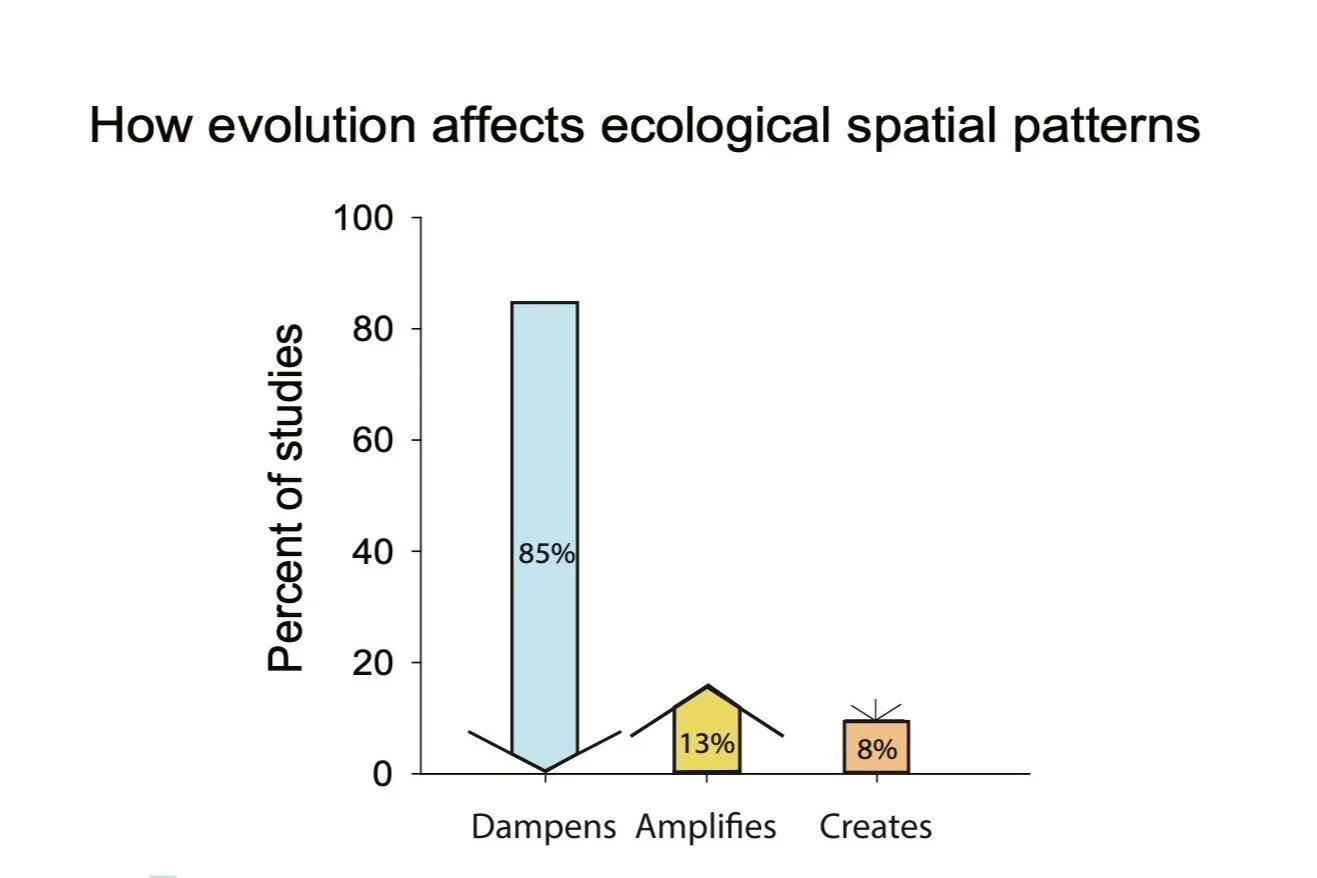
A new paper in PNAS lead by Mark Urban argues that evolution tends to dampen spatial heterogeneity in ecological conditions. The mechanisms vary, but adaptive evolution tends to minimize extinction and homogenizes population abundances in space - regardless of underlying environmental conditions.
Read More
Ongoing Research: Effect of Hurricane Dorian on Bahamas ecosystems
With collaborators Jonah Piovia-Scott, Jason Kolbe, and Oriol Lapiedra, I recently returned from a NSF-funded research trip to Abaco Island, The Bahamas to assess how a model system of island ecosystems fared after Hurricane Dorian. The trip was short but productive, setting the stage for a followup trip - hopefully sometime in 2021.
Read More
Ongoing Research: Dominican Republic field trip
A successful research trip to Barahona peninsula in the Dominican Republic. It wasn’t my research, by I’m always happy to lend a hand! A bit of adventure and loads of new species observations such as this little Anolis brevirostris.
Read More